

Numerical Modeling for Underground Mine Dewatering
CLIENT
AngloGold Ashanti
LOCATION
Crixás, Goiás State, Brazil
TIMEFRAME
2021-2022
Need more info? Contact Us!
Challenges
The study area is an underground mining operation with galleries reaching depths of up to 1030 meters. As the galleries advance, intersecting aquifer systems and/or geological structures with water recirculation, dewatering becomes necessary to prevent water accumulation inside the underground galleries. The mine is divided into six different sectors, each containing different ore bodies. Dewatering is required in three of these sectors, which have had a pumping flow monitoring system in place since 2020. Over the monitoring period, the average pumped flow across the three sectors is approximately 400 m³/h.
The challenge is to simulate scenarios associated with different stages of the mine’s life, aiming to estimate dewatering rates for future pits and galleries outlined in the mining plan, and to assess potential impact areas within the mine’s zone of influence.
Solution
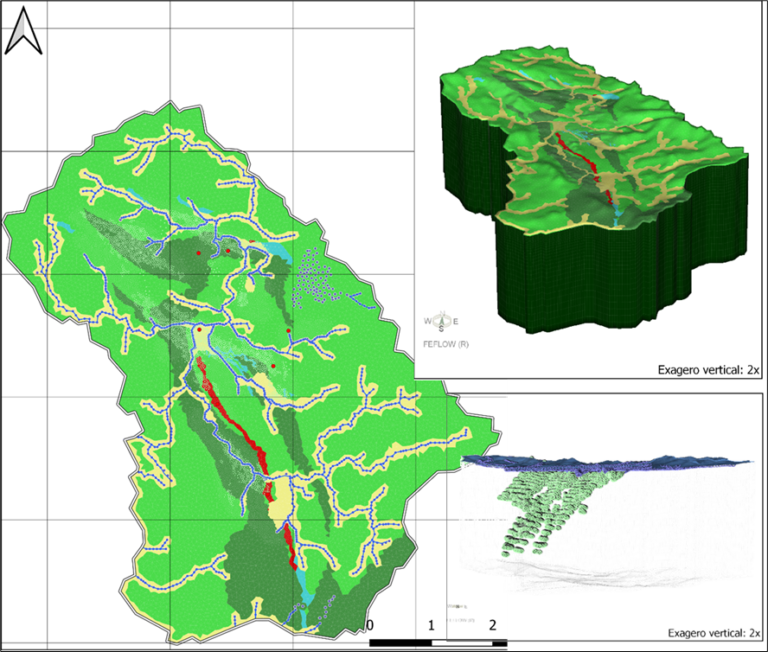
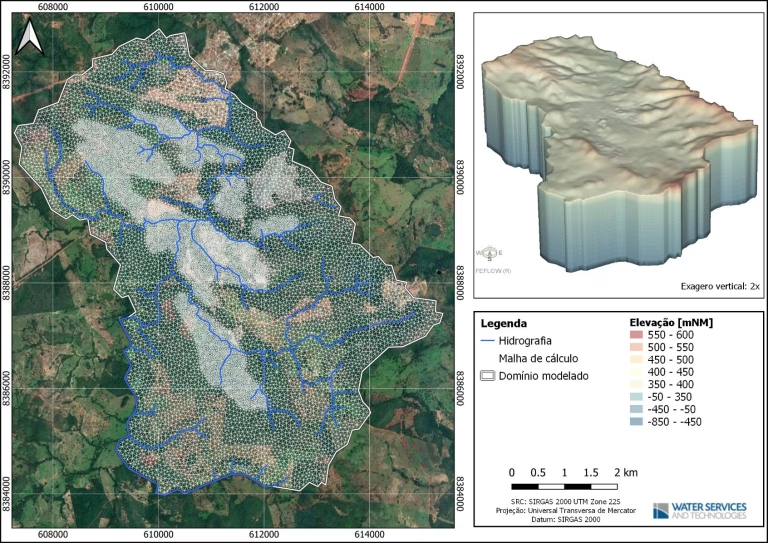
A historical data survey was conducted to understand the regional geological and hydrogeological conditions, followed by the development of a conceptual model. A regional three-dimensional numerical model covering 38 km² was developed. The equivalent porous medium approach was adopted to describe groundwater dynamics, using the FEFLOW software, due to the known fracturing system in the study area and the expansion of underground galleries.
Results
The numerical model was able to estimate orders of magnitude for future dewatering rates as a function of the expansion of underground galleries and open pits, as well as evaluate impact trends on watercourses under the influence of mining operations.
The simulation of gallery expansions and future pits enabled the projection of the dewatering system’s scale to meet the mining plan. Two dewatering scenarios were configured for the open pits: one relying solely on sump dewatering and another hybrid scenario combining sump and pumping wells.
The aquifer drawdown demand, necessary for dewatering to support the mining plan, interferes with the groundwater dynamics. Thus, estimates of impacts on springs were made by comparing the current condition with different stages of mine operation. The analysis aimed to represent the evolution of water level drawdown caused by gallery dewatering. It was observed that, in future scenarios, the drawdown cone estimated by the model could extend further, potentially impacting springs and watercourses under the influence of the mining operation.