
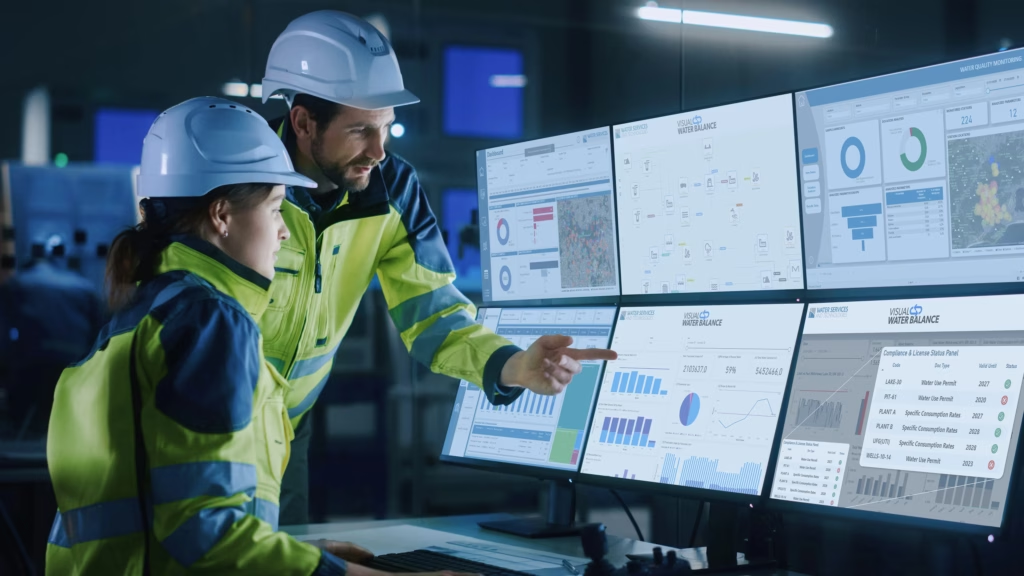
How Dashboards Are Driving Smarter, More Sustainable Water Management in Mining
In the age of digital transformation, the mining industry faces growing pressure to not only boost productivity but also to operate sustainably and transparently. Water—one of mining’s most critical and closely monitored resources—is at the center of this transformation.
Gone are the days when managing water meant simply tracking intake and discharge through siloed spreadsheets and manual reports. Today, forward-thinking mining companies are embracing digital dashboards as the foundation for a more efficient, sustainable, and ESG-aligned future.
But how exactly do dashboards improve water management? And how can mining operations turn complex field data into actionable insights?
Let’s dive into the story of digital dashboards and their role in reshaping sustainable mining.
Why Data (Not Just Water) is the Lifeblood of Sustainable Mining
Water is essential to nearly every step of a mining operation—from mineral processing and dust control to cooling equipment and managing tailings. But managing water wisely is about far more than tracking how much is used.
It’s about understanding where it’s coming from, how it’s being used, where it’s being lost, and how it can be reused. And to do that effectively, companies need access to reliable, real-time data.
Modern mining operations generate vast amounts of data daily, with information collected from various sensors that monitor water levels, flow rates, water quality, equipment performance, and environmental conditions. However, a significant portion of this data—estimated to be as much as 70%—remains unused, despite its potential value.
This unutilized data represents a missed opportunity to optimize operations and reduce environmental impacts, particularly considering that proactive measures could mitigate up to 80% of potential environmental impacts. (How mining industry can benefit from predictive analytics – NS Energy))
The International Council on Mining & Metals (ICMM) emphasizes that consistent, transparent water metrics are essential for benchmarking and improving water stewardship across the industry. However, the reality on the ground is often less than ideal: data is collected in fragmented ways, stored in unconnected systems, and used reactively rather than strategically.
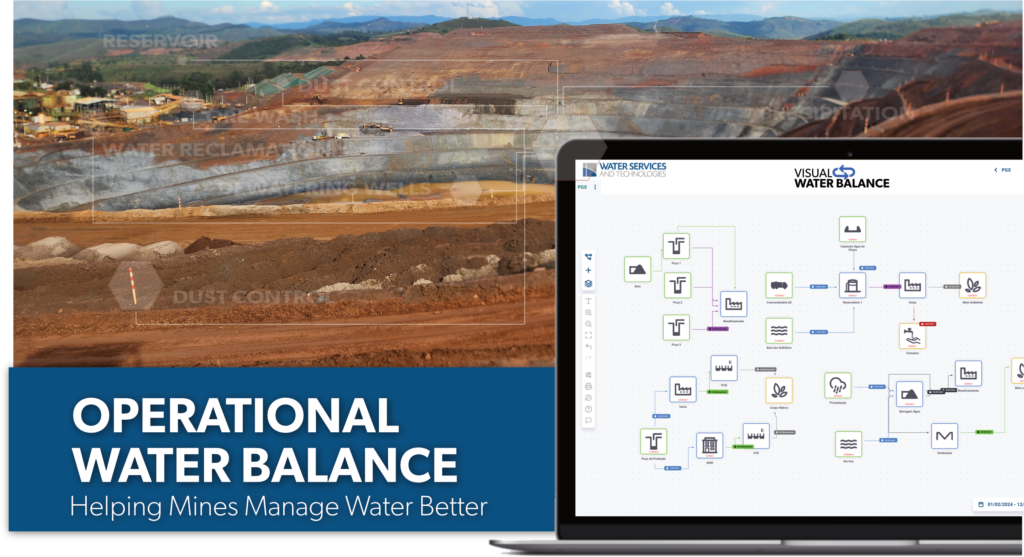
Dashboards change this equation. They act as command centers for water intelligence, consolidating data from across the operation and transforming it into a story—one that reveals inefficiencies, risks, and opportunities.
From the Field to the Boardroom: Building a Single Source of Truth
Collecting data in mining environments has never been easy. Sites are remote, field conditions are harsh, and connectivity is often limited. Traditionally, data was logged manually with pen and paper—leading to transcription errors, inconsistencies, and delays.
Today, apps like the WST Fielder are closing this gap. Designed for field teams, these tools allow users to:
- Enter data directly at the source (even offline),
- Automatically georeference measurements,
- Apply validation rules on the spot to ensure quality and consistency.
This shift in field data capture isn’t just about convenience—it’s about integrity. When measurements are standardized and validated immediately, data flows into the system faster and with fewer errors. This allows for near-real-time analysis, accelerating the feedback loop between field teams and decision-makers.
However, collecting high-quality data is only half the battle. Many mining operations still face a major hurdle: integrating that data across departments and systems.
That’s where tools like the WST Integration Tool come in. This technology ensures that data from various sources—field devices, sensors, lab reports, SCADA systems—is automatically aggregated into a centralized, harmonized database. No more data silos. No more duplicate entry. Just one reliable source of truth.
Benefits of full integration include:
- Faster and more accurate database updates,
- Lower operational costs through automation,
- Improved governance and traceability,
- Seamless implementation of compliance protocols.
Turning Numbers Into Narrative: Dashboards That Tell a Story
Once your data is centralized and cleaned, you can begin the real magic—transformation into strategic insights.
Dashboards serve as the user interface for complex operations. Instead of scrolling through spreadsheets or juggling reports, managers and engineers can now glance at a visual panel that shows exactly what they need to know:
- How much water was consumed today?
- Are reuse targets being met?
- Is a sudden spike in discharge signaling a leak?
The beauty of dashboards lies in their flexibility. You can customize views by role (e.g., site manager vs. ESG officer), location, or timeframe. You can also create interactive elements—charts that filter by month, alerts that notify teams when thresholds are breached, and comparative KPIs across different units.
Even more powerful: dashboards make it easier to communicate insights. Whether you’re presenting to internal leadership, engaging with community stakeholders, or submitting compliance data to regulators, dashboards simplify the message without sacrificing depth.
The Metrics That Matter: From KPIs to ESG
Water management isn’t just an operational concern—it’s a strategic one. Mining companies must now demonstrate their environmental performance to a growing set of stakeholders, including investors, governments, and the public.
To do this effectively, they need clear, consistent, and transparent metrics. Dashboards make these metrics visible, measurable, and—most importantly—actionable.
Some of the most impactful indicators for mining operations include:
Indicator | Why It Matters |
Water Efficiency (%) | Measures how much water is reused, supporting resource conservation goals. |
Specific Water Consumption (m³/t) | Tracks water use per ton of ore, revealing operational efficiency. |
Reuse Index (%) | Shows reliance on recycled vs. fresh water—key for ESG. |
Regulatory Compliance (%) | Tracks adherence to environmental regulations and permits. |
Sustainability Investments (US$/year) | Reflects financial commitment to ESG initiatives. |
With automated dashboards, these indicators are updated in real time and displayed in formats that support strategic decisions—from adjusting operations to responding to new regulations.
Building ESG Branding and Gaining Investor Confidence
Today’s investors are looking beyond balance sheets—they want to know how companies are contributing to a sustainable future.
Water stewardship is increasingly viewed as a proxy for broader ESG performance. Mining companies that embrace digital water management not only improve their environmental impact, but also:
- Enhance transparency and stakeholder trust,
- Reduce the risk of fines or shutdowns,
- Access ESG-linked funding opportunities.
According to the United Nations Sustainable Development Goals (SDGs), sustainable water management is a global priority. Companies that align with this agenda can position themselves as responsible stewards of natural resources—and gain a competitive edge.
Dashboards support this positioning by offering clear, auditable evidence of environmental performance. No greenwashing. Just data.
Where We’re Headed: A Blueprint for the Future of Mining
The digitalization of water management is not a futuristic concept—it’s happening now. And for mining companies that want to lead rather than follow, operational dashboards are the foundation.
By combining structured data collection, intelligent integration, and real-time visualization, dashboards enable:
- More efficient water usage,
- Faster response to anomalies or risks,
- Stronger ESG compliance and reporting,
- Better-informed, data-driven decisions.
Mining is evolving. Regulations are tightening. Resources are scarcer. And stakeholders are demanding more transparency. Companies that leverage dashboards today are not just improving operations—they’re future-proofing them.
Because in modern mining, smart water management isn’t just about saving water—it’s about building a smarter, more resilient business.
WST in Action: Building Digital Foundations for Sustainable Mining
Behind every powerful dashboard is a smart, scalable digital infrastructure—and that’s where Water Services and Technologies (WST) comes in.
We’ve partnered with mining companies to design, implement, and scale fully integrated data hubs tailored to their operational and environmental needs. These aren’t off-the-shelf tools—they’re custom digital ecosystems built to unify water, environmental, and operational data in a way that drives decision-making at every level of the business.
Our digital services team works side by side with clients to:
- Standardize and streamline field data collection using apps like WST Fielder,
- Integrate siloed systems into centralized databases with our WST Integration Tool,
- Design interactive, cloud-based dashboards that transform data into action.
We’ve helped operations move from paper and spreadsheets to real-time, automated insights—reducing costs, increasing compliance, and vastly improving governance. In fact, many of the mines we support now operate with fully functional water management dashboards that update daily, support ESG reporting, and trigger alerts when anomalies occur.
See the Dashboards in Action
Want to explore what a modern mining water dashboard looks like? Click the links below to view and interact with real examples we’ve developed in collaboration with our clients. These demos highlight KPIs such as water balance, efficiency, reuse, and regulatory compliance:
- Visual Water Balance
- Water Quality Report
- Monitoring Plan Management
- Environmental and Sustainability
- Quality Assurance and Control
Each dashboard tells a different story—of better governance, smarter operations, and measurable sustainability outcomes. And behind each one is WST’s commitment to combining environmental expertise with digital innovation.
To learn more about how our Digital Services are supporting the future of mining, explore our latest solutions or reach out to schedule a personalized demo.
Because the future of mining isn’t just digital—it’s intelligent, integrated, and WST-powered.

Martin Draeger, B.E.S.
Managing Partner, Director Business Development and Strategic Marketing
Water Services and Technologies | Canada
295 Hagey Blvd., 1st Floor, Waterloo, ON Canada
Tel. 519-807-9844
Email: [email protected]