
Hydrogeochemical modeling is an approach that takes into account physical and chemical aspects to represent a system made up of solid, liquid and gaseous matrices.
From this perspective, in addition to chemical reactions, geological aspects (mineralogy, lithochemistry and hydrogeology), hydrological phenomena and the influence of atmospheric gases are taken into account.
To give you an idea, in order to prepare hydrogeochemical models of mining structures, Water Services and Technologies develops and constantly updates a protocol for implementing these models.
Below are the main lessons learned, as well as tips for fully developing hydrogeochemical models, both conceptual and numerical, from the perspective and experience of Water Services and Technologies.
- 1- Every model is a puzzle. Each piece is important and has the right place. That’s why you need a multidisciplinary and innovative team to give you a diversified view
- 2- The quality of model results depends on the quality of the input information. Bad data can jeopardize the outcome of predictions. Initial data analysis and processing are essential. To do this, you will need statistical tools and a critical view of the information available
- 3- A conceptual model describes real phenomena. A numerical model describes these phenomena using mathematical equations. This means that there are simplifications to be made. Therefore, make sure that the simplifications applied are consistent with the complexity required
- 4- Hydrogeochemical models, in essence, deal with the description of phenomena based on the interaction of aqueous and solid phase(s). Therefore, it is important to know aspects related to hydrogeology, hydrology, geotechnics, geology and mineralogy, as well as the chemical phenomena themselves.
- 5- The aspects related to geology and mineralogy will mainly provide the characteristics of the solid phase of the numerical model, such as the lithotype(s) and respective mineral phases to be considered. The representativeness of each lithological unit is provided by geological models. Make sure that the analytical and instrumental methods used in the mineralogical analysis are suitable from a qualitative point of view, but also quantitatively.
6- The hydrogeological parameters will provide information on residence time, flow paths and preference within the structure, as well as the degree of saturation. Together with the geotechnical aspects and criteria for arranging the structures, they will support inferences about oxidizing and reducing zones, water level formation, which are closely related to the redox potential of the aqueous phase. The water balance will help identify different sources of water, as well as possible hydraulic connections
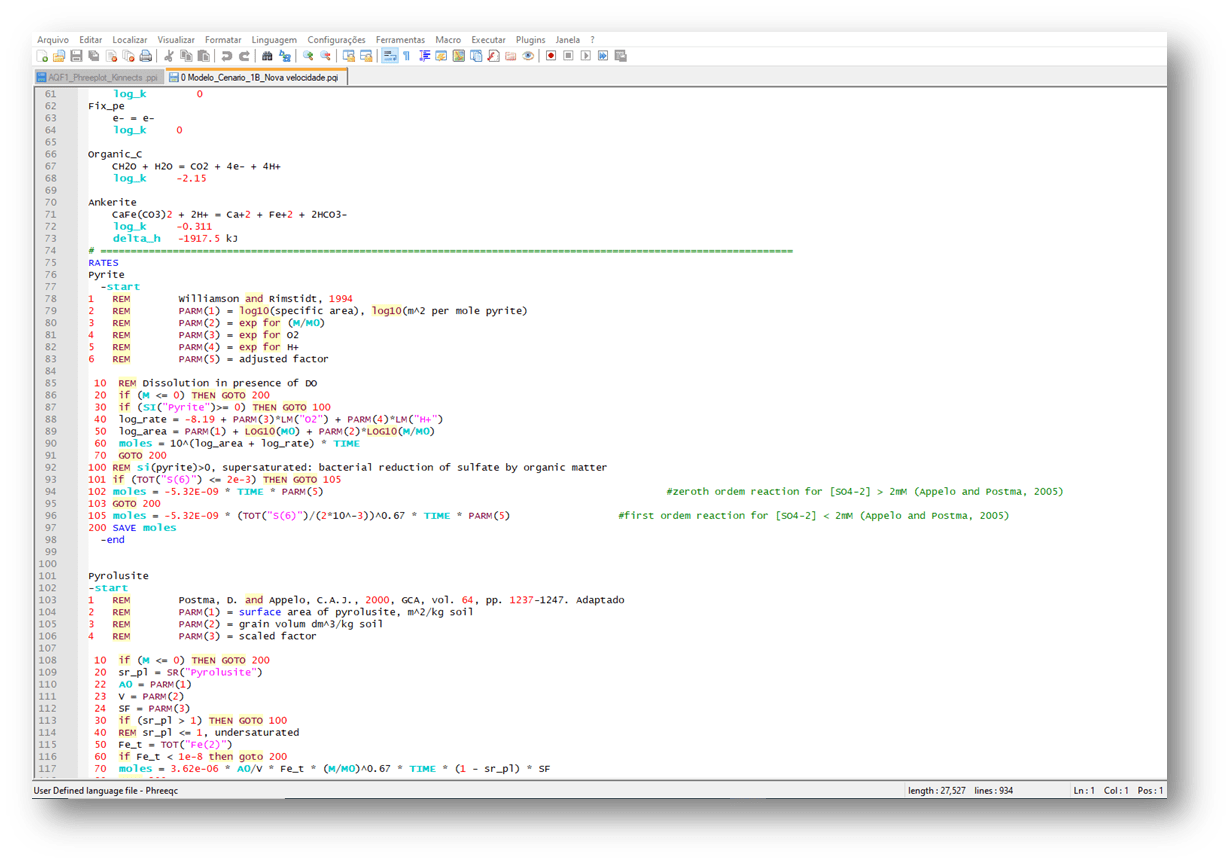
7- In order to carry out hydrogeochemical simulations, it is important to establish the possible phenomena and reactions beforehand, especially in order to interpret and understand the results. Therefore, the possibility of oxy-reduction reactions, the influence of atmospheric gases, pH and Eh variations, leaching and solubilization of minerals, as well as precipitation and saturation of the aqueous phase should be considered
8- Select relevant chemical parameters for the numerical model. The standards and variation ranges of the selected parameters should be evaluated from the implementation of the numerical model through to the calibration and sensitivity analysis stages.
9- Numerical model implemented. It’s time to run it. The results obtained must be critically analyzed. If necessary, return to the conceptual model. For this reason, always calibrate and carry out a sensitivity analysis of the numerical model to assess the consistency of its results.
Implementing the numerical model takes less than 10% of the effort. Therefore, invest in the conceptual stage and make sure that the phenomena and parameters being considered are consistent. Finally, remember: always use an integrated approach, which can be the difference in your work.