
Have you ever considered the impact that groundwater can have on a mine’s stability?
In projects where every technical decision is crucial to ensure safety, efficiency, and sustainability, integrating hydrogeology with geotechnical studies is not just beneficial — it’s essential.
Uncontrolled or poorly understood groundwater percolation can reduce rock mass strength, cause internal erosion (piping), trigger mass movements on slopes, and compromise critical structures such as open pits, waste piles, and tailings storage facilities.
Beyond Traditional Geotechnics
Geotechnics, by definition, studies the mechanical behavior of soils and rocks to guarantee the stability of slopes, dams, pits, and piles.
However, rising pore pressures due to subsurface water can reduce rock mass resistance, provoke internal erosion (piping), cause leakage in tunnels and galleries, trigger slope movements, and compromise the performance of tailings dams or waste pile foundations.
Ignoring these effects can lead to structural failures, operational risks, and severe environmental impacts.
In many projects, hydrogeological aspects such as regional flow, fractured media behavior, recharge variability, and aquifer connectivity are treated too simplistically — which limits long-term predictive capacity.
Integrating hydrogeology and geotechnics allows for more comprehensive analyses, strengthening the robustness of proposed solutions.
A clear example can be seen in a numerical modeling study developed by Water Services and Technologies (WST) for a large-scale mining operation in southeastern Brazil.
Numerical Modeling for Predictive Insights
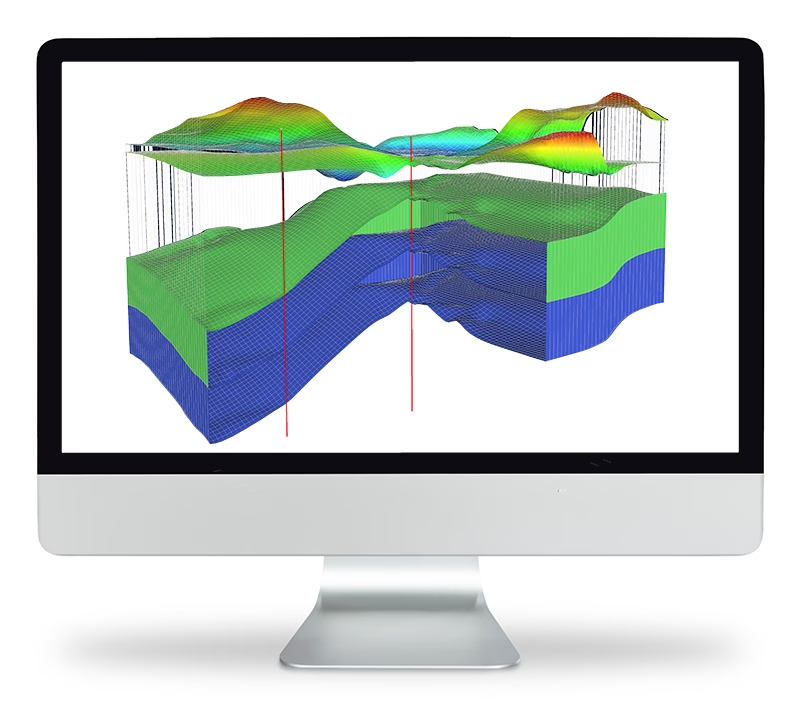
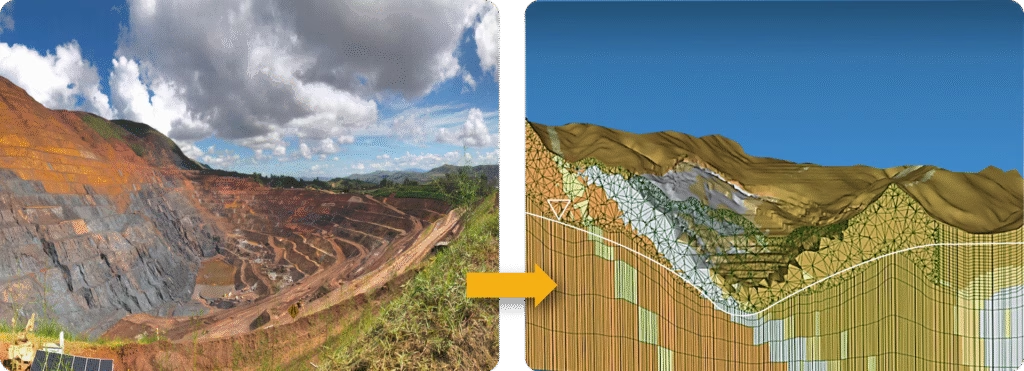
A fully integrated 3D hydrogeological model was built to simulate the effects of progressive pit excavation, groundwater drawdown, and long-term recovery during mine closure.
The calibrated model accounted for unsaturated zone behavior, hydraulic connectivity between geological units, and stress-dependent permeability variations.
This allowed WST to estimate pore pressure distribution over time and identify high-risk zones for slope instability under operational and post-operational conditions.
The Importance of Hydrogeological Integration
This is where hydrogeotechnics comes in — as an integrated approach combining geotechnics and hydrogeology to bring more precision and predictability to mining engineering projects.
By coupling hydrogeological modeling with geotechnical design, it becomes possible to more accurately predict system behavior.
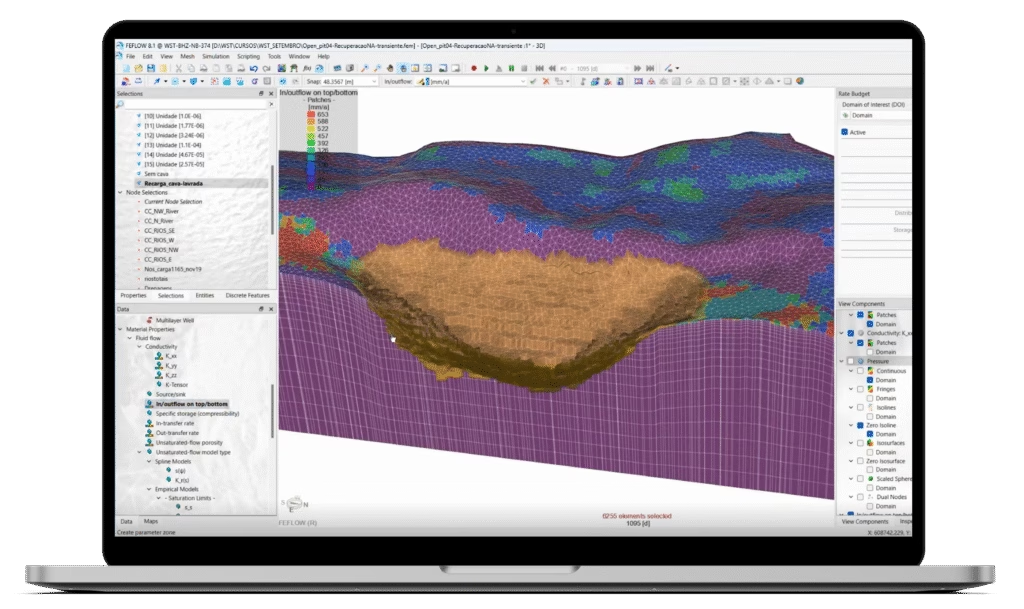
At Water Services and Technologies (WST), we employ advanced tools such as FEFLOW, Visual MODFLOW, PLAXIS LE, and GeoStudio to develop models that simulate groundwater flow coupled with geomechanical response.
This approach enables:
- 3D analysis of pore pressure distribution in complex stratigraphic environments;
- Simulation of slope behavior under various saturation conditions;
- Design of dewatering and pressure relief strategies;
- Long-term groundwater recovery forecasting after mine closure;
- Slope geometry assessment based on hydro-mechanical interaction;
- Detailed representation of complex features such as drainage systems, deep horizontal drains (DHDs), tunnels, galleries, faults, and fractures.
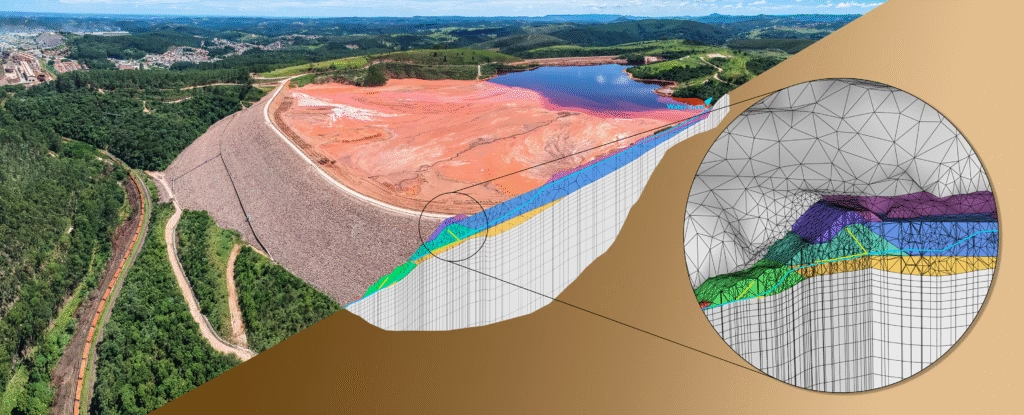
Projects involving dam decommissioning, pit backfilling with tailings, or deep mining slope design demand understanding that goes far beyond surface conditions.
From Field to Model: Lessons in Realistic Simulation
In the paper “Pit Lake Modeling for Impact Assessment and Closure Planning”, presented at the International Mine Water Association (IMWA) 2019, the authors highlight how simplified assumptions about post-mining hydrological recovery can lead to uncertainties in closure planning.
They recommend including hydrogeological expertise in the early project stages — focusing on understanding delayed water table rise, inter-basin flow, and geological barrier effects.
In one WST project, modeling efforts revealed that intrusive dikes within iron formations acted as partial hydraulic barriers, influencing potentiometric surfaces and pore pressure distributions.
Including these features in the numerical model allowed for a more accurate assessment of slope stability and preferential groundwater flow paths throughout the mine’s lifecycle.
From Data to Decisions: Reducing Uncertainty and Increasing Safety
Semi-coupled or fully coupled hydrogeotechnical modeling has proven to be a powerful tool for both technical understanding and long-term planning.
In semi-coupled approaches, hydrogeological analysis results directly inform geotechnical assessments.
In fully coupled models, geotechnical responses also influence flow analyses.
At WST, modeling workflows are grounded in site-specific geological, climatic, and operational data, enabling:
- Understanding the mutual effects between flow and geotechnical behavior;
- Improved design of geotechnical structures under varying saturation conditions;
- Risk assessment of seepage and barrier effectiveness;
- Scenario planning for extreme weather events and excavation progression;
- Environmental evaluations supported by integrated simulations.
Through this approach, we aim to reduce uncertainty and provide clients with a stronger technical foundation for strategic decision-making.
Expertise You Can Trust
At Water Services and Technologies, we unite hydrogeological and geotechnical expertise to deliver fully integrated solutions.
Our experience in mining and infrastructure projects demonstrates that hydrogeotechnics is a practical and efficient approach to improving predictability, performance, and structural safety.
Want to know how hydrogeotechnical modeling can support your project?
Contact our technical team and discover how WST can add value through precision and innovation in challenges involving geotechnics and groundwater.


Marina Ribeiro
Mining Engineer
Water Services and Technologies | Brazil
Bernardo Figueiredo Street, 33, Serra, Belo Horizonte-MG, Brazil
Email: [email protected]